How I Became OpenAI's First Prompt Engineer
Dive deep into an AI frontier, rigorously test and document prompts, and openly share useful findings to stand out and land a pioneering role like OpenAI's first prompt engineer.
Working at a company like OpenAI, I often get asked: how does somebody get a job there?
If you’re inside tech—especially inside AI—you already kind of understand the typical routes. You work at another lab, somebody recruits you, you go get a degree at one of the bigger schools, you build a reputation in the right circles. A lot of it is “how do you get on the radar.”
But you can also just flat-out apply. The hard part is having the credibility to do that.
I got in in a very unconventional way. And it started with a tweet.
Not the tweet you think—just the fact that I was paying attention.
How I First Started Paying Attention to OpenAI
I probably first heard Elon Musk talk about OpenAI and took an interest because it seemed like one of the first groups really taking the possibility of artificial intelligence seriously—outside of DeepMind.
DeepMind had done some interesting things, but there was something compelling about this smaller group and the way they were approaching it.
So I followed OpenAI’s progress. I watched the announcements. I remember when they showed the robotic hand that could solve a Rubik’s cube—something I actually got to see in person on my first day visiting their old office.
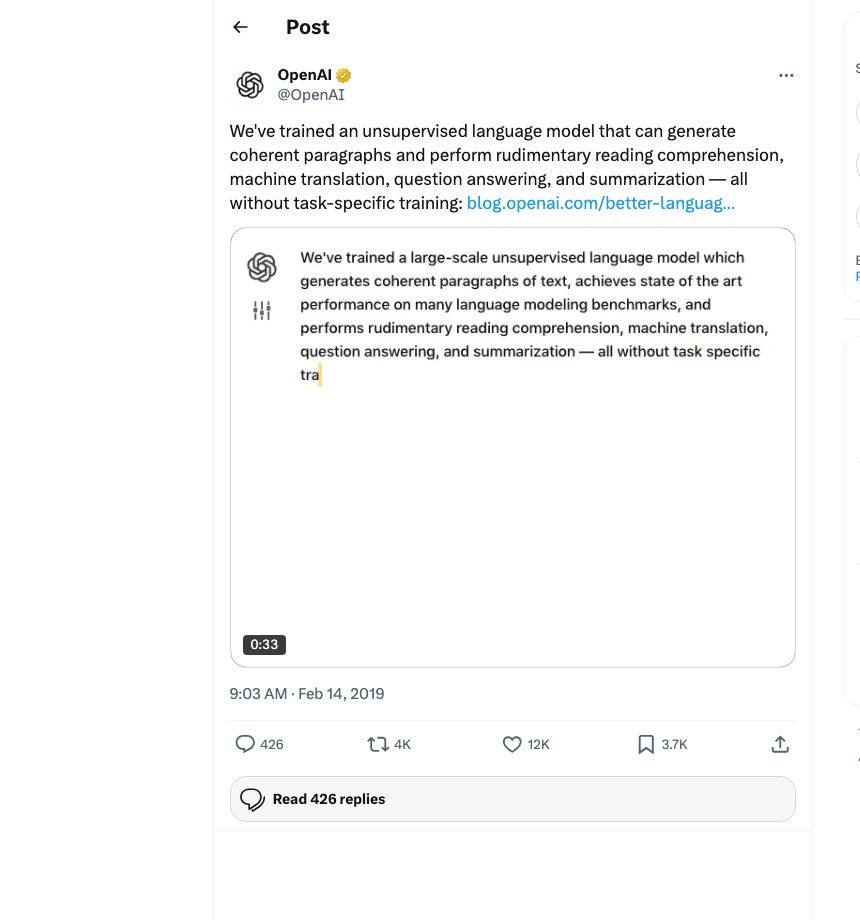
But what really made me stand up and pay attention was February 2019, when OpenAI published that first tweet about GPT-2.
GPT-2 Was a Big Deal (At the Time)
OpenAI announces GPT-2: a new model, incredibly capable. This was the one we jokingly talked about as “maybe too dangerous to release.”
That’s laughable now, but at the time there was nothing like it. It was leaps and bounds ahead of what we’d seen.
Before that, “AI text generation” was mostly small predictors that could do sentiment analysis, or generate a little text… and it all kind of sucked. I’d even built my own text generators, so I had a very grounded sense of the state of the art. GPT-2 was a real leap forward.
When they posted the announcement, I replied with a joke:
“Oh, this is really exciting. Any advice for a soon-to-be out-of-work novelist?”
Of course I wasn’t literally saying I thought it would replace novelists overnight. Writing novels is an entirely different skill set. It was just my way of saying: this feels like a new era.
A year later, I was working for them.
And it wasn’t because of that tweet. It was because I paid attention.
I Read Everything They Published
Once OpenAI announced GPT-2, they released a ton of examples of what it could produce on GitHub.
I read every single output. Every single thing they did.
One example really stuck with me: the several-hundred-word article it wrote about discovering a tribe of unicorns in the Andes Mountains. It was the longest piece of AI-generated text I’d ever seen that was coherent.
It started strong—coherent, grounded, readable—and then, several hundred words in, it started describing the unicorns as having two horns.
That detail is burned into my brain because it made me curious about what the model was doing internally. It had a clear understanding early on, it could relate concepts later, but its awareness of its own text started to drift.
To me, the fact that those first couple paragraphs were so coherent told me a lot. There was something there—something that could become very important if it could be scaled.
So I played with GPT-2 versions when it became possible. I tried to understand what it got right, where it broke, and why.
Even then, it was hard to evaluate. Its general intelligence wasn’t great. But it had the roots of something. And I could see where it might go.
Getting Access to GPT-3 (And Taking It Seriously)
After GPT-2, there wasn’t much mainstream talk about it until GPT-3 started being disclosed to people under NDA.
This is where all my obsession with GPT-2 suddenly mattered.
Because I’d been talking about GPT-2—why it was interesting, what it was doing, what I thought was coming—somebody at OpenAI heard me at a time when very few people outside of AI and fringe tech were paying attention.
That led to an invite to test GPT-3.
Plenty of people got invited, so I’m not pretending I was uniquely chosen. But the difference was what I did with it once I had access.
I took everything I’d learned from GPT-2 and applied it to GPT-3. And one of the big lessons I’d already internalized was: you learn a lot from limitations.
In psychology, you often learn the most not from perfectly functioning people, but from people with impairments. The famous example is Phineas Gage—the guy who had a railroad spike go through his brain, and whose personality and behavior changed in ways that helped people understand how the brain works.
Small models are like that. Their limitations are obvious. When you scale up, the limitations don’t always go away—they just become harder to see. You feel frustrated, but it’s not clear why.
Because I’d studied GPT-2’s “jaggedness,” I had a better instinct for what I was seeing in GPT-3.
For example: you can only make prompts (instructions) so long. If you make them too long, coherence starts to fall apart. I built all kinds of tests—never even formalized them into a test bench, but I had them—and I could roughly measure where the model would lose the plot.
So I played with GPT-3 nonstop.
Sharing What I Found (Instead of Hoarding It)
As I discovered things, I started showing the API team different capabilities—what worked, what didn’t, what seemed surprisingly reliable, what seemed like an illusion.
That led to them asking me questions, because they had business clients trying to figure out what they could do with this thing.
At some point I had to make a decision.
I’d found (what I thought were) pretty interesting prompts—some of which ended up in the prompt library, which I helped write. And I felt like I had an advantage. I understood things about prompting that almost nobody else did at the time.
So I had a choice:
Should I keep this to myself and go start a company? Or should I share it and help push the technology forward?
I decided to share it.
I decided that what would be possible if we kept building and iterating on top of the model would be way more interesting than trying to keep some prompt “secrets” for myself.
In retrospect, I think it was a great choice.
I ended up not creating a company (another story), although they did feature one of my apps.
And the main point is: I got in by diving deep into a thing they released, figuring out everything cool about it, finding all the jagged edges, and giving helpful feedback.
I treated it seriously.
That’s what led to them asking me if I wanted to work for them.
I became their first prompt engineer—although my title was technically “Member of Technical Staff” (Creative Applications).
What I’d Tell Anyone Trying to Break Into AI Right Now
If you’re trying to get into this space, my advice is simple:
Find the frontier. Then live there for a while.
There are a lot of interesting places on the fringe right now—especially in AI. I can think of a dozen things that nobody’s exploring as well as they could, outside of maybe some of the bigger labs.
Some of that frontier might be smaller models. Some might be new approaches to training reasoning models. A huge one, in my opinion, is data.
Data is an underappreciated lever. Synthetic data is poorly understood by most people, and there are so many different avenues for doing it well.
Whatever you pick, the play is the same:
Go deep. Learn the tool better than most people. Document what you find. Share it in a way that’s genuinely useful.
You don’t have to be “inside” to get on the radar.
But you do have to take the work seriously.